This time, the Steam demo festival kicked off with alarmist statements about the overwhelming presence of AI-created projects. However, the results paint a far more interesting and complex picture. We delve into this, as well as the winners in terms of wishlists, subscribers, and other metrics, in our comprehensive report.

“Neuro-slop” Did Not Win: What the Data Says About More Than 7,000 Games
October’s Steam Next Fest set a record for the number of participants, which was expected. However, no one anticipated there being quite so many. Over 7,300 demos can be tracked, with initial submissions exceeding 8,000. This is about 70% more than the June event and 110% more than in February.
The competition clearly became even fiercer. Amidst the massive influx of participants in the early days of the festival, heated discussions started up online about the prevailing amount of so-called “neuro-slop.” Some groups of users even called for Valve to add specific filters for such content.
Nonetheless, many forget that during the first 48 hours, titles in different sections of the festival are shown randomly. During this so-called "blind" period, Steam collects statistics and data, which is why chaos reigns at the start of every festival. This time, it's just on a larger scale, with the accessibility of advanced AI tools.
By Wednesday, however, Valve engages personalized recommendation algorithms, and the usual charts appear (popular demos, leaders by wishlist count, and recent activity). This doesn't magically remove all the “slop.” But real results show that the dreadful AI games — surprise — aren’t desired by anyone.
To avoid making baseless claims, we checked over seven thousand projects for the presence of a disclaimer about the use of generative AI. Such a label, which doesn't inherently make a game “slop,” is present on the pages of more than 34% of the festival participants. It looks scary!
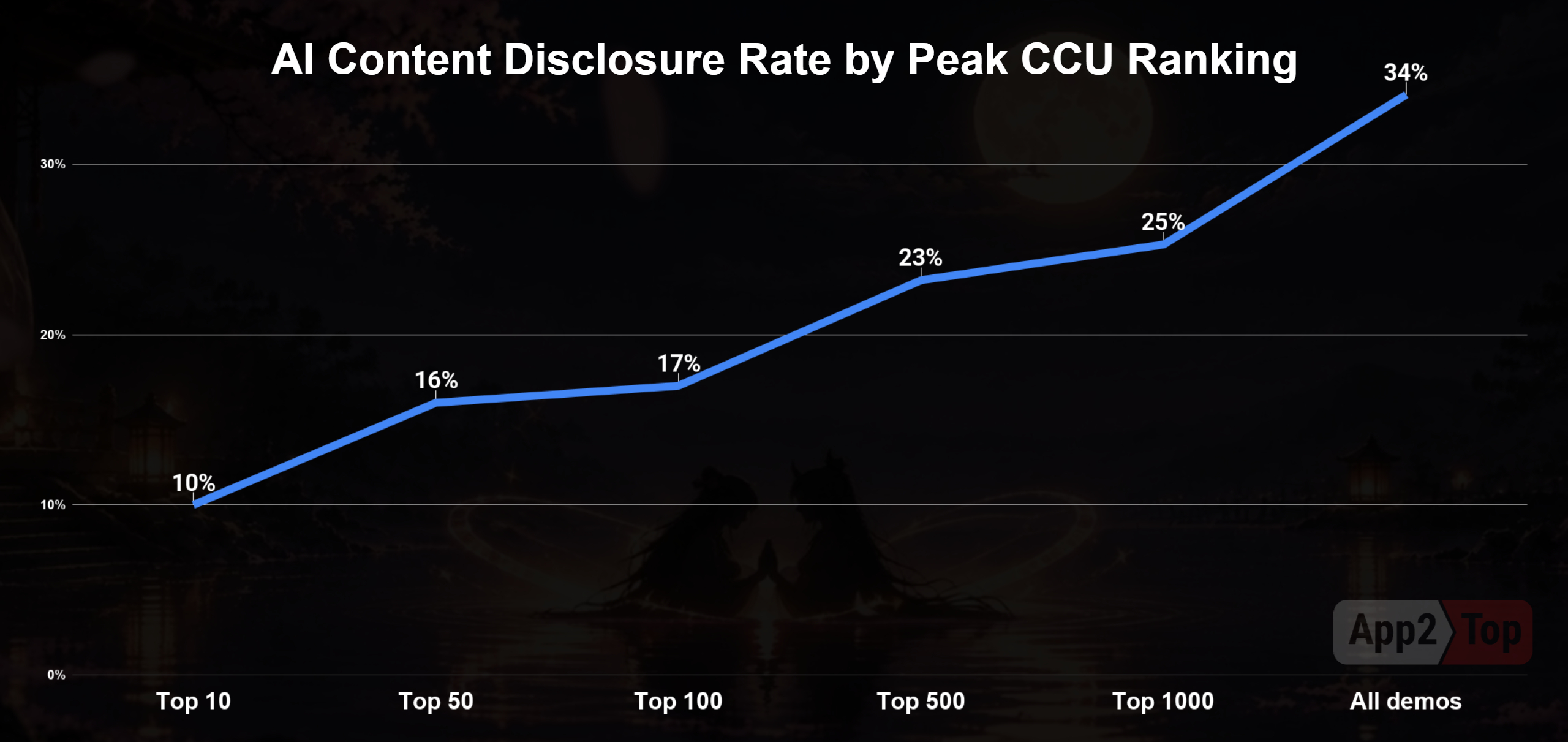
In reality, data demonstrates that most low-quality projects naturally ended up at the very bottom in most key metrics. For instance, if you sort all demos by peak online presence, an interesting trend emerges:
The farther from the top, the larger the share of games that disclose the use of generative AI
- Among the top 10 by online count, only one game has an AI Content Disclosure — ArcheAge Chronicles;
- In the top 50, there are only eight such projects — 16%;
- In the top 100, the share increases to 17%; in the top 500 — to 23.2%, and in the top 1000 — to 25.3%.